Decorating a master bedroom It has an added difficulty: the space belongs to two people.
Therefore, before thinking about colors, headboards or curtains, it is advisable to resolve something more basic: how the room will be used.
Where does everyone keep their things? What do they need next to their bed? Does anyone read at night? When these questions are clear, decorating becomes much easier.
The bed as a starting point
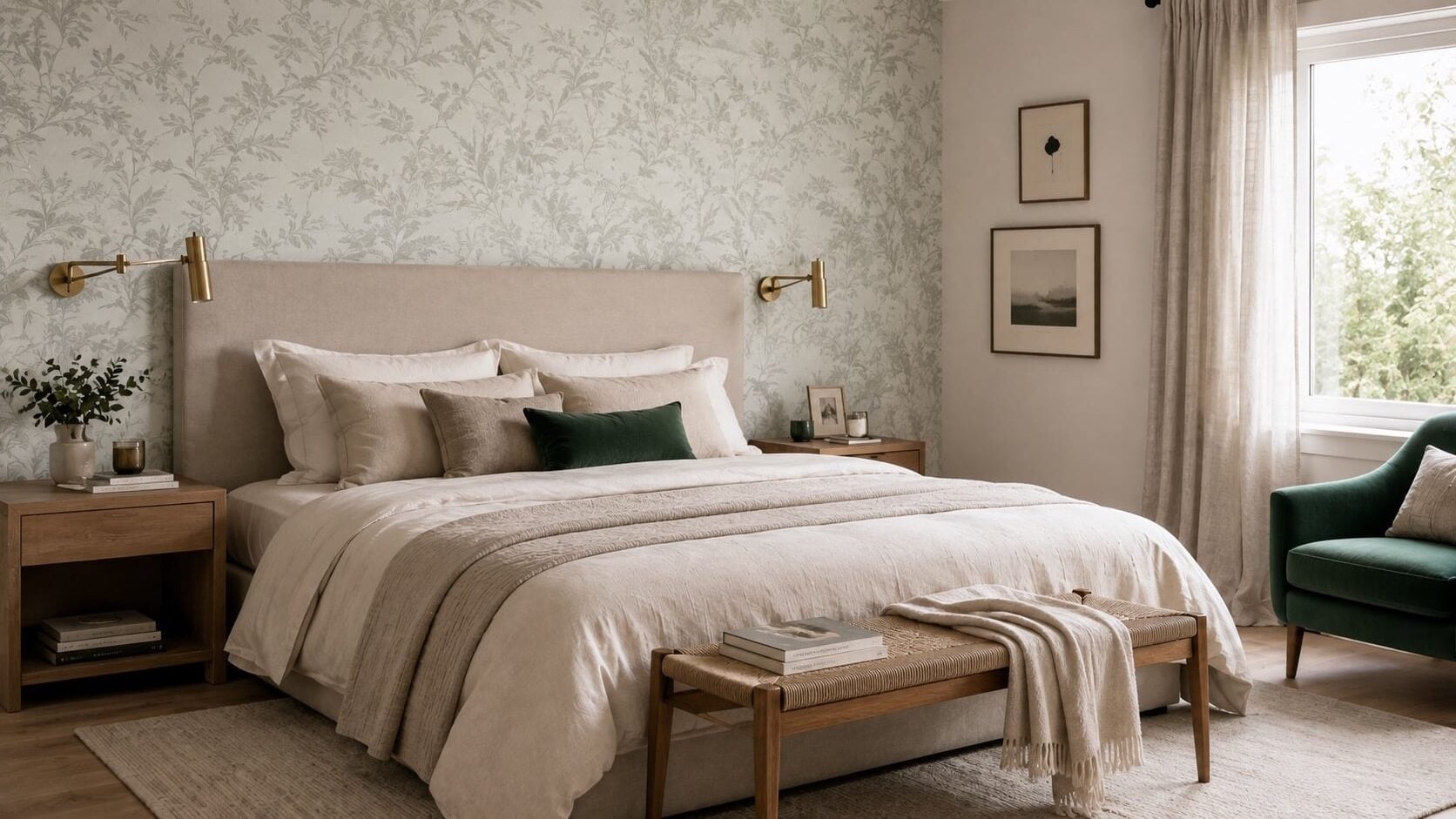
The bed is usually the largest volume in the room and a good reference point for arranging everything else.
In a spacious bedroom, we can complement it with generous bedside tables, statement lamps, or a bench at the foot of the bed. When space is limited, each piece needs to justify its price.metros that it occupies.
It's not enough for the furniture to fit. You have to be able to open drawers, access the wardrobe, and move comfortably on both sides of the bed.
In our Flamenco skirts category bedroom decor You can find different items to complete the stay.
Wallpaper to highlight the headboard wall
The wall behind the bed is usually the first thing you notice when you enter. Wallpaper allows you to give it presence without adding furniture and helps to visually frame the headboard.
The design doesn't have to be flashy. A small motif, soft stripes, or a textile-like finish work well if you're aiming for a serene room. If you prefer something with more character, a botanical or geometric print can take center stage.
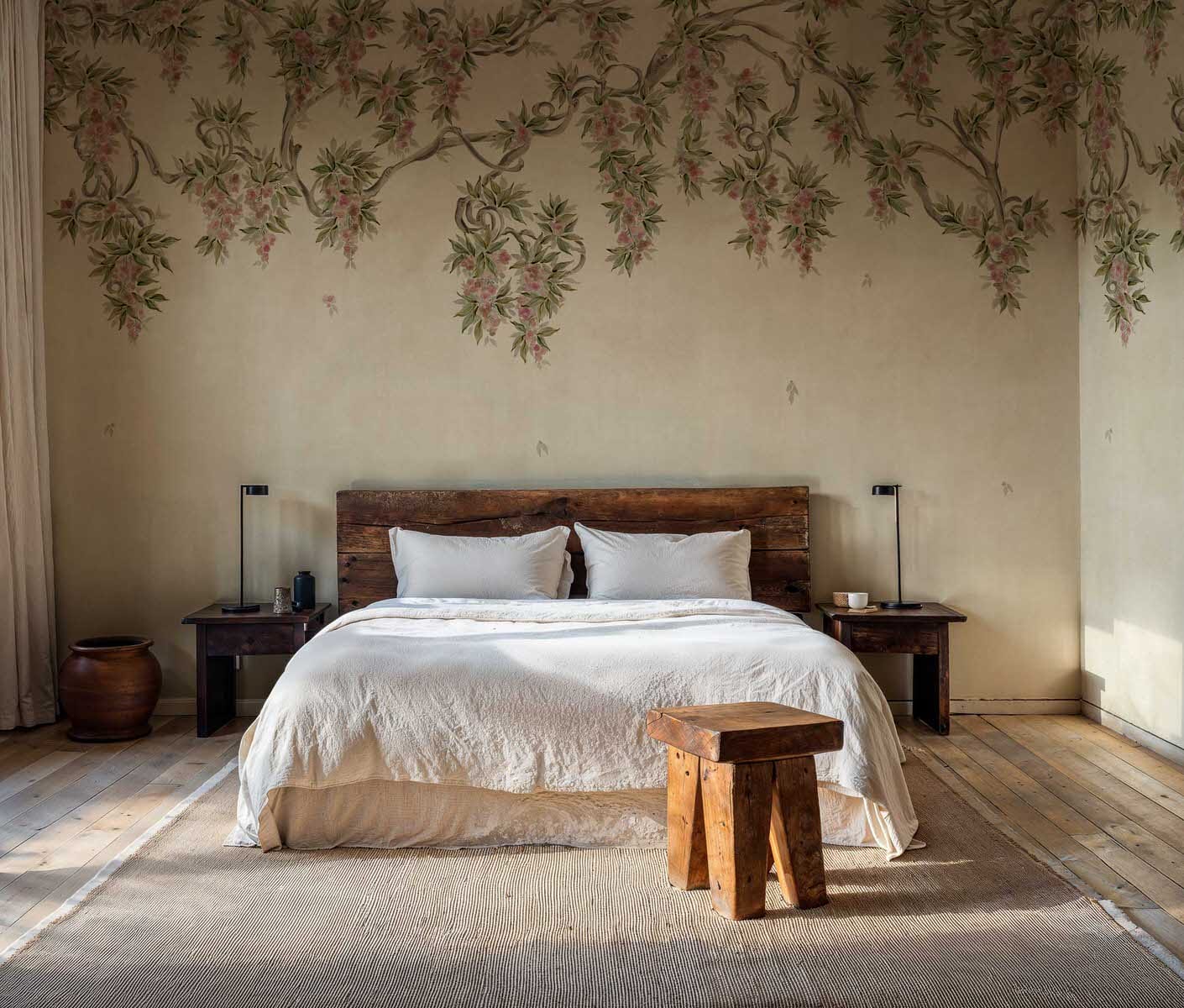
It's not necessary to wallpaper the entire bedroom either. Reserving the design for the headboard wall allows you to use more distinctive patterns without overwhelming the room.
In our article on Wallpaper for bed headboards You'll find more ideas for working on this area.
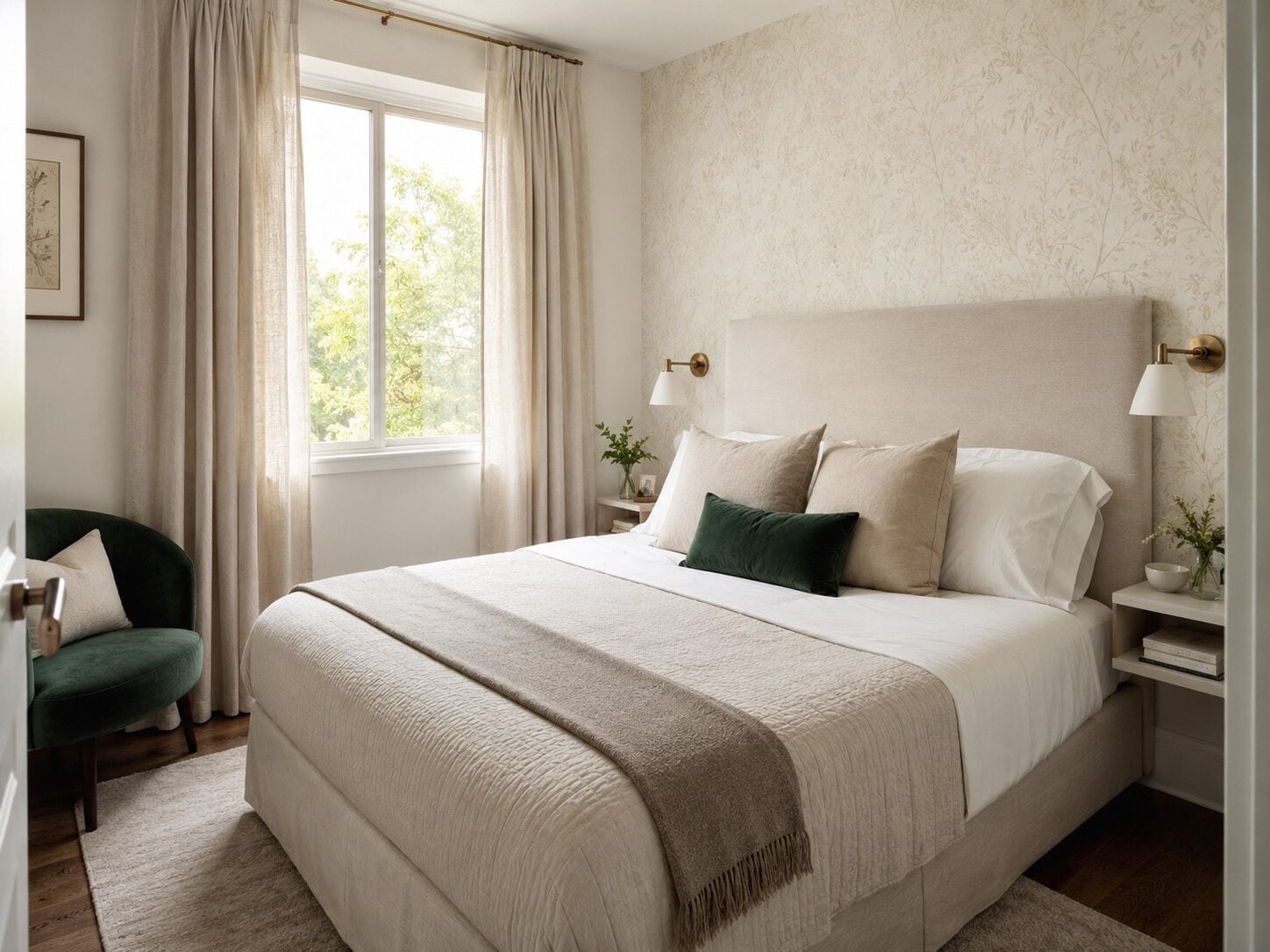
Al decorating the wall of a master bedroomIt's best to consider the overall look. Wallpaper, headboard, bedside tables, and lamps are all seen practically at the same time. If one item has significant visual weight, the others don't need to compete with it.
A custom-made headboard to organize the bed area
On a double bed, the headboard occupies a significant surface area. Its size is just as important as the fabric or color.
It can be adjusted to the width of the mattress or extended to the sides to also integrate the bedside tables. This second option visually widens the composition and gives the wall more presence.
Upholstered headboards also allow for the introduction of texture and considerable freedom in color choice. chic & fabric We have custom-made bed headboards which can be customized with the chosen upholstery.
Here, we'd avoid coordinating everything too obviously. If the wallpaper has a lot of pattern, a plain headboard usually works better. With a more neutral wall, we can opt for a fabric with a bolder look.
It is enough that there is some link between the two: usually an accent color or a small detail of the pattern.
Curtains and blinds to control the light
In the bedroom, window dressing isn't just a decorative decision. The orientation, the amount of morning light, and the level of darkness needed for sleep should all be considered in the choice.
Curtains add more fabric and soften the room. Installed near the ceiling and down to the floor, they can also make the room appear taller.
The blind takes up less space and is especially practical when there is a chest of drawers, a radiator or other furniture near the window.
If we need to severely limit the amount of light entering the room, we can use opaque fabrics. Among our options are custom-made blinds You will find solutions to better adjust the brightness.
Another possibility is to combine layers: a light fabric that filters the light during the day and a more opaque one for the night.

Coordinate the bedding
The bed takes up a huge amount of space in the bedroom. What we put on it completely changes the overall perception of the room.
A simple way to get it right is to start with a base: a plain quilt, a textured fabric, or a print you want to highlight. From there, add only the layers you actually use.
You don't need five rows of cushions. A bedspread, a throw, and a few pillows can perfectly dress the bed.
It also tends to look more natural when the fabrics are related but don't appear to be a pre-packaged set. We can repeat a color scheme, mix textures, or reserve the print for the cushions.
With our service of custom-made bedding It is possible to make different pieces with the chosen fabrics and coordinate them with the rest of the bedroom textiles.

A well-proportioned rug transforms the bedroom area.
With rugs, proportion matters. A rug that's too small in front of a large bed often looks lost.
When space allows, a rug that partially fits under the bed and extends over the sides and foot of the bed works best. If the layout doesn't permit this, you can also place two smaller rugs, one on each side.
In addition to making the floor more comfortable, the rug helps to visually unite the bed, headboard and bedside tables.
You can see different options in our selection of alfombras para dormitorio.
If there's already a lot of pattern on the wallpaper or bedding, we'd choose a more understated rug. With a bedroom in solid colors, there's more room to introduce a graphic design or a bold texture.

Decorating a small master bedroom
When they are missing metroYes, the scale of the furniture becomes crucial.
Two bulky side tables can take up space we might need for moving around. Instead, we can use narrow models, small hanging shelves, or wall sconces that free up floor space.
It's also a good idea to look upwards. Tall furniture allows you to gain storage without taking up more floor space, and curtains installed near the ceiling visually lengthen the wall.
Concentrating the decor around the headboard area also helps. It's better to create a focal point there than to scatter many small objects throughout the room.
And no, a small bedroom doesn't have to be white. Wallpaper, an upholstered headboard, or a deeper color can work very well if the other elements allow the space to breathe.
Latest trends in master bedroom decor: which ones are worth adapting
Trends are useful for discovering ideas, not for redoing the bedroom every few years.
One of the easiest to implement at home is the use of textures. Linens, embossed fabrics, woods, and matte finishes create depth even when working with a very limited color palette.
We also see bedrooms where the wall takes center stage over an accumulation of furniture. Wallpaper, a mural, or simply a well-chosen color can be enough.
Another interesting idea is a less rigid symmetry. The two small tables or the two lamps don't have to be identical. They can share material, proportion, or color and still form a balanced set.
Two people, two lighting needs
In a shared bedroom, it's worth considering each side of the bed separately.
Perhaps one person reads before bed and needs focused light, while the other prefers softer lighting. In that case, placing two identical lamps for the sake of symmetry doesn't really address the actual use of the room.
The light fixtures can be different and still be related by the finish, size or color.
Symmetry is nice when it works. Everyday comfort outweighs the benefits.
How to make the bedroom not feel impersonal
A bedroom can be perfectly coordinated and yet seem unused.
Personal belongings break that feeling. Books, photographs, a souvenir from a trip, or a piece of furniture that was already at home can coexist with new elements.evoYes, without any problem.
Not everything has to belong to the same collection. In fact, rooms are often more interesting when they bring together pieces chosen at different times.
La decorating a master bedroom It works especially well when both people recognize something of themselves in it.
That's why you don't have to solve everything at once. First, the layout, the bed, the lighting, and the textiles. Then you can add those pieces that make the bedroom feel like yours and not just a room set up for a photograph.